
For decades, the City of Green River, Wyoming, relied on a wastewater lagoon system originally built in 1962 to serve its residents and businesses. While lagoon systems are common in smaller communities, changing environmental regulations, aging infrastructure, and increasing operational demands made it clear that Green River needed a long-term solution capable of supporting the community well into the future.
That solution became the new Green River Wastewater Treatment Plant, a modern mechanical treatment facility designed to improve water quality, increase operational reliability, and provide long-term resiliency for the region.
Sunrise Engineering partnered with Burns & McDonnell to help bring the project to life, providing comprehensive construction management services throughout the multi-year effort.
Replacing Aging Infrastructure with a Modern Wastewater Treatment Plant
According to Rocky Mountain Water – Issue 6, 2024, the original wastewater treatment facility occupied approximately 34 acres and relied on an aerated and non-aerated lagoon system with screening, grit removal, aeration basins, ponds, and sand filters. While the system had served the community for decades, stricter regulatory requirements for phosphorus and E. coli reduction created the need for a more advanced treatment process.
“The existing lagoon system was getting old and was in need of repairs, along with more stringent requirements being set by regulatory agencies,” said Kevin Martin, PE, Sunrise Engineering Project Manager. “That caused the city to move on from the existing lagoon system into the mechanical treatment plant.”
The project officially began taking shape in 2015 as the city evaluated long-term infrastructure options. By 2017, Burns & McDonnell had been selected to design the new facility, with Sunrise Engineering joining the team to provide construction management services.
Sunrise’s ability to collaborate closely with Burns & McDonnell created a strong, unified project team.
“Sunrise was able to team with Burns & McDonnell to provide a complete team,” Martin said. “Burns & McDonnell handled the design, and Sunrise provided the construction management. By teaming together, it allowed us to be very competitive on engineering fees for the client.”
Managing a Large-Scale Infrastructure Project During COVID-Era Challenges
While the project’s technical complexity was significant, one of the biggest challenges came from the timing of construction.
The project was initially bid in 2019 during a period of extreme construction cost escalation and supply chain uncertainty caused by the COVID-19 pandemic. According to Martin, the first round of bids exceeded the City’s available budget, requiring the project team to work closely with the city and funding agencies to identify solutions.
“The city asked the design team to value engineer the design as they concurrently secured additional budget for the project from funding agencies,” Martin explained. “The project was bid again in 2021 only to have the price increase despite value engineering efforts.”
Bigfoot99 News later reported that inflation and supply chain delays ultimately increased the project cost from an originally anticipated $30 million to approximately $55 million.
“COVID also affected the project due to long lead times of certain components, especially electrical items,” Martin said. “That required the entire team to be creative with schedule and construction sequencing.”
Throughout construction, “Sunrise worked closely with the contractor, owner, and design team to address questions and issues as they were found and help provide a solution,” Martin said.
Delivering a State-of-the-Art Wastewater Treatment Facility
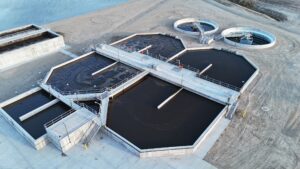
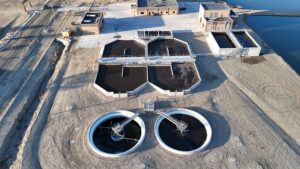
The new Green River Wastewater Treatment Plant officially came online in January 2026 and now provides the city with significantly improved treatment capabilities and operational control.
The new facility was designed for an average daily flow of 1.25 million gallons per day, with peak flow capacity of 3.5 million gallons per day.
The project included:
- An 8,632-square-foot administration building with laboratory space
- A 4,570-square-foot process building
- A 6,410-square-foot UV and dewatering building
- Mechanical screening and grit removal systems
- Anaerobic selector basins
- Oxidation ditches
- Secondary clarifiers
- Aerobic digesters
- UV disinfection systems
- More than 2,600 linear feet of 24-inch FEFF piping
According to SweetwaterNOW, the treatment process relies heavily on biological treatment methods rather than chemical additives. Operators carefully manage oxygen levels and mixing conditions to encourage microorganisms to naturally remove phosphorus, ammonia, and nitrogen from the wastewater stream before discharge.
“It’s all about creating the right conditions,” wastewater operator Anthony Hodges told SweetwaterNOW. “You turn air on or off, change mixing, and the bugs do the work for you.”
The facility also incorporates redundancy throughout the plant, allowing operations to continue even if individual components require maintenance or experience failure.
“If we have to shut one system down, we can still run the entire plant on the other,” Green River Public Works Director Mark Westenskow told SweetwaterNOW. “That flexibility also helps operators manage flows when wastewater levels are low.”
Supporting Environmental Stewardship and Community Growth
Beyond replacing aging infrastructure, the new treatment plant provides important long-term environmental benefits for the community and the Green River itself.
“The new WWTP plant will be able to meet the more stringent discharge requirements for phosphorus and E. coli,” Martin said. “That will benefit the Green River and those that use it for recreation.”
The upgraded treatment process also gives the city greater control over water quality before treated water is discharged back into the river. The project has already attracted attention from other Wyoming communities facing similar infrastructure challenges. According to Bigfoot99 News, officials from Rawlins were invited to tour the facility as they began planning major water infrastructure improvements of their own.
Showcasing Teamwork, Expertise, and Coordination
Projects of this scale require strong coordination, communication, and organization across multiple teams and disciplines.
At peak construction, Martin said the site regularly had 50 to 60 workers representing multiple trades working simultaneously across the facility.
“Strong organization processes and planning skills were required by the Sunrise team to observe the critical aspects of the project, keep detailed notes, coordinate with the contractor, owner, and funding agencies, track quantities, and generally keep up with, if not think ahead of the contractor,” Martin said.
Sunrise Engineering provided:
- Full construction observation and administration
- Pay application review
- Field work orders
- Weekly OAC meetings
- Submittal and change order support
- AIS compliance review
- Davis-Bacon wage surveys
The project demonstrates Sunrise Engineering’s ability to successfully manage large-scale infrastructure projects while coordinating with owners, contractors, designers, and funding agencies under challenging conditions.
Most importantly, the project delivers a reliable, resilient wastewater treatment system that will serve the Green River community for decades to come.
Works Cited
“Green River Wastewater Plant Is Now Online.” SweetwaterNOW, by James Riter, January 27, 2026.
https://www.sweetwaternow.com/green-river-wastewater-plant-is-now-online/
“Green River Invites Rawlins Council to See New Wastewater Plant.” Bigfoot99 News, April 1, 2026.
https://bigfoot99.com/bigfoot99-news/green-river-invites-rawlins-council-to-see-new-wastewater-plant/
“Green River Wastewater Treatment Plant.” Rocky Mountain Water, Issue 6, 2024, pp. 27–29.
https://issuu.com/kelmanonline/docs/rocky_mountain_water_issue6_2024